If you’ve ever been driving along the M27 and suddenly seen a small, yellow horseshoe-shaped light pop up on your dashboard, you’ve met your TPMS (Tyre Pressure Monitoring System). While it might feel like just another annoying light to deal with, this system is one of the most significant safety advancements in modern automotive history.
However, as many drivers in Portsmouth and across the UK have discovered, TPMS isn’t without its quirks. From batteries dying at the worst possible time to sensors snapping off during a routine tyre change, these little devices can be a major headache for the average motorist.
In this deep dive, we’re going to look at exactly what TPMS is, why it is a legal requirement in the UK, common issues that cause that dreaded light to flash, and why programming these sensors is often more complicated than a simple “plug and play” job.
What Exactly is TPMS?
TPMS stands for Tyre Pressure Monitoring System. Its job is simple: to keep an eye on the air pressure inside your tyres and alert you if it drops below a safe level—usually 20% to 25% below the manufacturer’s recommended PSI.
Direct vs. Indirect TPMS
Not all systems work the same way. Manufacturers generally use one of two methods to monitor your tyres:
| Feature |
Direct TPMS |
Indirect TPMS |
| How it works |
Physical sensor inside each wheel. |
Uses ABS wheel speed sensors. |
| Measurement |
Reads actual pressure and temperature. |
Calculates “apparent” pressure via rotation. |
| Accuracy |
Extremely high; pinpoint precision. |
Less precise; can be slow to react. |
| Maintenance |
Sensors require battery/service kits. |
No sensors, but requires manual resets. |
| Cost |
More expensive to repair/replace. |
Cheap to maintain (software-based). |
TPMS and the UK MOT Test
Since November 1, 2014, EU and UK law has mandated that all new passenger cars must be fitted with a TPMS. This isn’t just a suggestion; it is a critical safety feature.
The MOT Rule: If your car was registered after the 1st of January 2012 and the TPMS light is illuminated on the dashboard, it is an automatic MOT failure. This catches many Portsmouth drivers off guard. You might have perfectly legal tread depth, but if that sensor isn’t communicating, you aren’t getting your certificate.
Common Problems with TPMS Sensors
While the system saves lives and helps fuel economy, the sensors live in one of the most hostile environments on the vehicle.
1. Battery Depletion
Direct TPMS sensors are powered by small lithium-ion batteries sealed inside the unit. These batteries generally last between 5 and 10 years, or roughly 100,000 miles.
The Issue: These batteries are not replaceable. Because the units are resin-sealed to be airtight and waterproof, once the battery dies, the entire sensor must be replaced.
2. Galvanic Corrosion
Most TPMS sensors use an aluminium valve stem. In the UK, we use a lot of road salt during the winter months. This salt, combined with moisture, causes galvanic corrosion. The metal becomes brittle, and often the valve cap or the internal valve core becomes seized. If you try to unscrew a seized cap with pliers, the entire stem can snap off, leaving you with an instant flat tyre.
3. Damage During Tyre Fitting
TPMS sensors are delicate electronic components. If a technician is inexperienced or using older tyre-changing equipment, the “bead” of the tyre can catch the sensor as it is being levered off the rim. A single slip-up can result in a snapped sensor that costs £60–£100 to replace.
The Programming & Relearning Puzzle
One of the biggest frustrations for car owners is that you cannot simply buy a sensor off the shelf, fit it, and expect the light to go out.
The Programming Stage
Many sensors sold today are “universal.” They come blank and don’t know if they are being fitted to a Ford Focus or a BMW 3 Series. A technician must use a specialised TPMS diagnostic tool to “burn” the correct vehicle protocol onto the sensor chip.
The Relearn Process
Once the sensor is programmed and fitted, the car’s ECU (its brain) needs to be introduced to its new teammate. This is called a “Relearn.” Depending on your car, this could involve:
-
Auto-Relearn: Driving the car at a consistent speed (over 20mph) for about 20 minutes.
-
Stationary Relearn: A sequence of button presses or ignition cycles (e.g., “Press brake, turn key three times, hoot the horn”).
-
OBD Connection: Plugging a diagnostic tool into the car’s computer to manually “write” the new sensor ID into the system memory.
Typical TPMS Costs
Keeping your system maintained is cheaper than ignoring it. Below is a rough guide to what you might expect to pay:
| Service |
Estimated Cost |
Why do it? |
| TPMS Service Kit |
£10 – £15 |
Replaces seals and nuts to prevent leaks. |
| Diagnostic Check |
£20 – £40 |
Identifies which sensor has a dead battery. |
| New Sensor & Coding |
£75 – £110 |
Replaces a broken or dead sensor. |
| Full Set Replacement |
£200 – £350 |
Best done when all batteries are reaching 8+ years. |
Expert TPMS Services in Portsmouth
If you are struggling with a flashing TPMS light or a “Sensor Fault” message, you don’t need to head to an expensive main dealer.
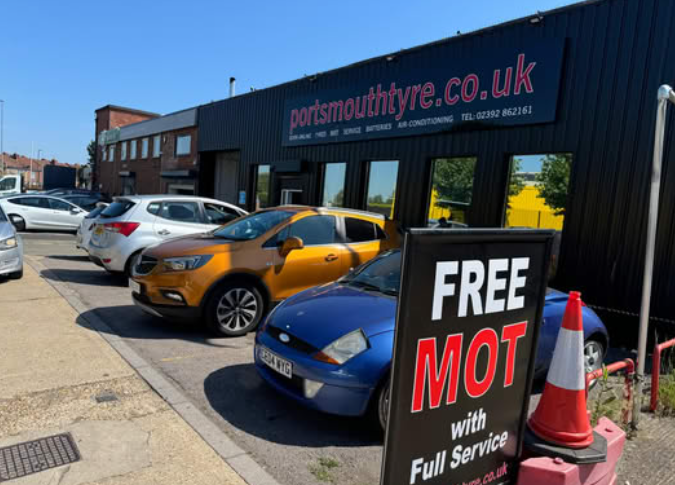
PortsmouthTyre.co.uk provides a comprehensive TPMS reprogramming service. We have the specialised diagnostic equipment required to “interrogate” your sensors without even taking the tyre off the wheel. We can check the exact battery percentage and signal strength of each unit, identifying the culprit in minutes.
We provide:
-
Sensor Replacement: We stock high-quality sensors that match your vehicle’s original specifications.
-
Re-programming: If your system has lost its “memory” after a battery change or wheel swap, we can re-sync it for you.
-
Valve Stem Repair: If your sensor is fine but the metal stem has corroded, we can often replace just the stem, saving you the cost of a full electronic unit.
Summary
Don’t let a small sensor lead to a big MOT failure or an unsafe drive. By keeping your tyres at the correct pressure and ensuring your sensors are serviced every time you change your tyres, you’ll enjoy better fuel marks and a longer lifespan for your rubber.
Need help with your TPMS? Visit PortsmouthTyre.co.uk or drop into our Portsmouth workshop to get your sensors tested and your dashboard light cleared.